
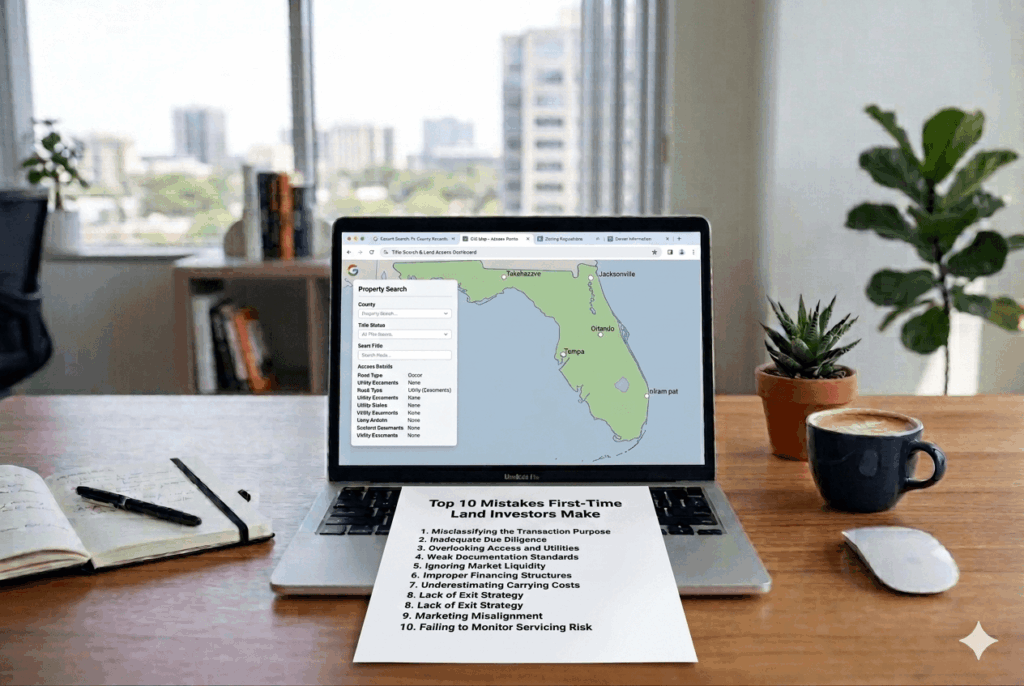
Buying raw land looks simple on paper. No tenants, no roof repairs, no maintenance calls at midnight. But first-time buyers consistently walk into the same traps — and in Florida’s land market, those traps carry real financial consequences. Here are the ten mistakes we see most often, and what you should do instead.
1. Skipping the title search
Raw land parcels — especially low-cost rural lots — carry title histories that are rarely clean. Inherited properties pass through multiple hands without proper documentation. Tax deed sales create ownership gaps. Liens from prior owners survive the sale. Buyers who skip a title search to save $200 sometimes inherit problems worth ten times that.
Always order a full title search and purchase an owner’s title insurance policy before closing. It is not optional.
Essential step before any offer.
2. Ignoring flood zone status
Florida has more land in FEMA-designated flood zones than most buyers realize. A parcel in Zone AE or VE is not unbuildable, but it carries mandatory flood insurance requirements, elevation certificate costs, and construction constraints that can make development economically unfeasible. Some buyers purchase without ever checking the FEMA Flood Map and discover the issue only after closing.
Pull the FIRM panel for every parcel. Factor flood status into your offer price before you make one.
Check FEMA FIRM maps at msc.fema.gov
3. Assuming the zoning fits the plan
A parcel zoned agricultural will not allow you to build a single-family home without a rezoning approval — which is not guaranteed and often takes twelve to eighteen months. Buyers frequently purchase land based on what they intend to do with it, without confirming the local zoning code permits that use. In Florida, zoning authority sits at the county level, and each county has its own land development code.
Call the county planning department before you submit an offer. Ask specifically whether your intended use is permitted by right or requires a special exception or rezoning.
Never assume, always verify with the county
4. Not confirming legal access to the parcel
Some Florida land parcels — particularly those carved from older subdivisions — are technically landlocked. There is no deeded easement or public road frontage providing legal ingress and egress. The parcel may appear reachable on a satellite image because a neighbor’s driveway runs adjacent, but that neighbor can close access at any time.
Confirm legal access through a survey or a title attorney before purchasing. A parcel without deeded access has severely limited utility and resale value.
Verify ingress/egress via recorded easements.
5. Underestimating the cost of utilities
Raw land in Florida typically has no water, sewer, or power at the parcel boundary. Connecting to municipal water and sewer — where it is even available — can cost $15,000 to $40,000 or more depending on distance. In rural areas, a well and septic system add $12,000 to $25,000 to the development budget. Buyers who price land without utility costs often find that a $30,000 parcel requires $50,000 in infrastructure before it can be used.
Get utility availability confirmations from the county and utility providers. Budget the full development cost, not just the purchase price.
Get utility availability letters before closing.
6. Overpaying based on list price alone
Land is harder to value than improved property. There are fewer comparable sales, wide variance in parcel characteristics, and no income stream to anchor a cap rate calculation. First-time buyers often treat the seller’s asking price as a market benchmark when it is not. In Florida’s rural markets particularly, list prices can sit above market for months or years with no adjustment.
Pull closed sales — not listings — from the county property appraiser’s website. Adjust for acreage, access, zoning, and utilities. Make offers based on data, not list price.
Base offers on closed comps, not asking prices.
7. Purchasing without a survey
Parcel boundaries on county maps and satellite overlays are approximations. In Florida, encroachments, boundary disputes, and easement conflicts are common on rural land with long ownership histories. A buyer who skips a boundary survey may find that a fence, drainage ditch, or access road sits in a different location than the legal description suggests — sometimes on their property, sometimes on a neighbor’s.
Commission a boundary survey by a licensed Florida surveyor before closing on any parcel. The cost is minor relative to the risk.
Boundary surveys prevent costly disputes.
8. Ignoring wetlands and environmental restrictions
Florida has extensive wetlands jurisdiction administered by the Florida Department of Environmental Protection and the U.S. Army Corps of Engineers. A parcel that appears dry in an aerial image may be classified as jurisdictional wetlands, which restricts or prohibits any development activity. The cost of a wetlands delineation is far less than the cost of a violation — or the cost of buying land you cannot develop.
Request a wetlands determination from a qualified environmental consultant on any parcel where development is the goal. This is non-negotiable in Florida.
FDEP and Army Corps jurisdiction applies statewide.
9. No exit strategy before the purchase
Raw land does not generate income. Every month of ownership has a carrying cost — property taxes, insurance, opportunity cost. First-time investors sometimes buy without a specific plan for how and when they will exit the position. The result is a parcel that sits for years, depreciating relative to inflation, while the owner waits for a vague “appreciation” that may or may not materialize on a relevant timeline.
Before you buy, define your exit: Are you developing? Selling to a builder? Leasing for agricultural use? Reselling to another investor? The exit determines what you should pay and what parcel characteristics actually matter.
Define exit before entry — always.
10. Holding title in the wrong name
First-time investors routinely take title in their personal name because it is simpler at closing. For investment or business-purpose land, this exposes personal assets to liability from the parcel and forfeits structural flexibility for seller financing, joint ventures, or 1031 exchanges. Florida LLCs offer pass-through tax treatment, liability protection, and significantly more transactional flexibility than personal ownership.
Consult a Florida real estate attorney before closing to determine the appropriate holding structure for your situation. Changing title after the fact is possible but adds cost and complexity.
Entity ownership protects personal assets.
Summary
Most of these mistakes share the same root cause: moving too fast. Land deals in Florida can close quickly, and that speed is sometimes treated as a signal to skip due diligence steps. It is not. The lower the price of the parcel, the more important the diligence — because low-cost land often carries the issues that low-cost land buyers are least equipped to absorb.
At Land By Owner, our sellers transact directly with buyers. There is no intermediary inflating the price or compressing the timeline. That access is valuable — and it works best when the buyer comes prepared.