
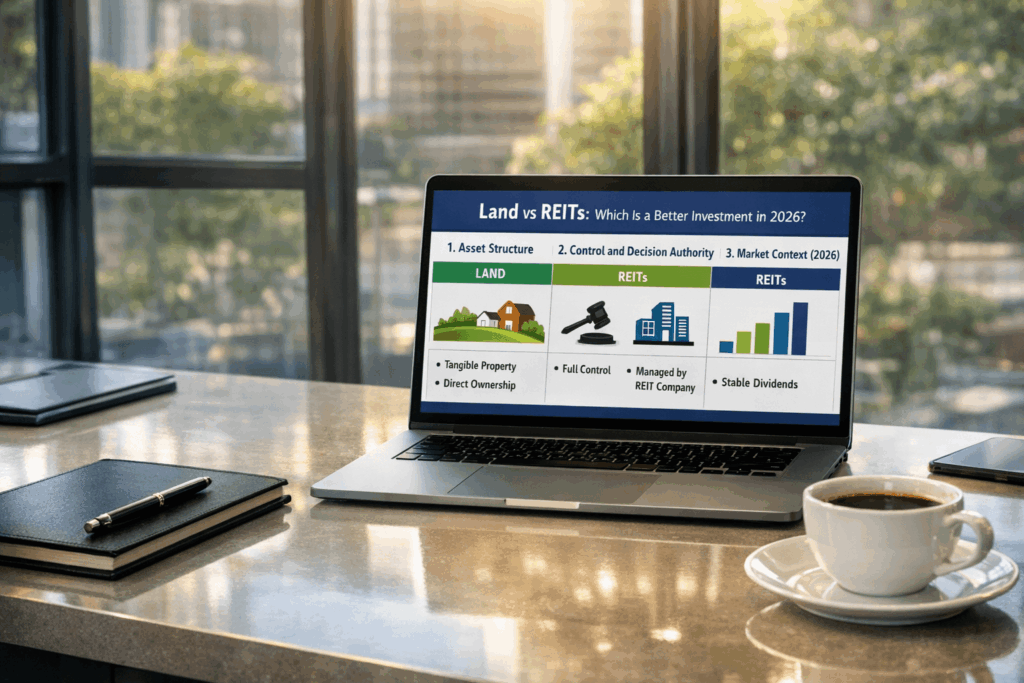
For capital allocators operating through legally formed entities, the distinction between direct land ownership and Real Estate Investment Trusts (REITs) is a structural consideration. Both provide exposure to real estate, but the mechanisms, control frameworks, and risk characteristics differ significantly.
This analysis is provided for business-purpose evaluation only. It is not intended for personal, family, or household investment decisions.
1. Asset Structure
Direct land ownership involves acquiring a legally titled parcel of real property in the name of an entity such as an LLC or corporation. The entity maintains full authority over acquisition, hold strategy, development timing, and disposition.
REITs are securities representing fractional ownership in a managed portfolio of real estate assets. The investor holds shares, while operational and financial decisions are made by the REIT management structure.
This is a distinction between direct asset control and indirect exposure through a managed financial instrument.
2. Control and Decision Authority
Entity-level land ownership provides:
- Full control over hold duration
- Independent timing of development or disposition
- Discretion over capital deployment
- Ability to structure exits based on entity objectives
REIT participation does not provide individual control. Decisions related to acquisitions, financing, distributions, and exits are centralized within the management structure.
This difference is structural and should be evaluated based on the entity’s operational preferences.
3. Market Context (2026)
REIT performance has reflected sensitivity to interest rates and broader equity market conditions. Valuations and returns vary based on sector exposure and management decisions.
Florida land markets in select counties continue to show activity tied to builder demand and inventory positioning. Availability and pricing vary by submarket and zoning characteristics.
Market conditions should be evaluated independently by each entity based on its acquisition criteria and risk tolerance.

4. Liquidity Characteristics
REIT shares can generally be transacted through brokerage accounts, providing higher liquidity.
Direct land ownership is inherently illiquid. Disposition requires a transaction process involving marketing, negotiation, and closing.
Liquidity differences should be evaluated in the context of the entity’s time horizon and capital planning strategy.
5. Income Characteristics
REITs are structured to distribute a portion of taxable income to shareholders, which may result in periodic dividend income.
Vacant land does not produce income unless structured. In business-purpose transactions, seller-financed dispositions may generate installment-based cash flow at the entity level.
These structures are commercial in nature and do not involve consumer credit underwriting.
6. Tax Considerations
Entity-held land may allow for:
- Like-kind exchange structuring
- Deductibility of certain holding and operational expenses
- Flexibility based on entity tax election
REIT distributions are generally treated as income subject to applicable tax rules.
All tax treatment is dependent on entity structure and should be evaluated with qualified advisors.

7. Capital Deployment
REIT participation typically requires lower initial capital outlay.
Direct land acquisition may involve structured purchase terms between entities, including documented down payments and installment arrangements.
These transactions are conducted for business purposes only and are not structured for consumer use.
8. Risk Characteristics
Direct land ownership:
- Full operational control
- Illiquid structure
- Market exposure tied to local conditions
- No inherent income unless structured
REIT participation:
- No individual control
- Higher liquidity
- Exposure to equity market volatility
- Income dependent on portfolio performance
Each structure carries different operational and market risks that should be evaluated at the entity level.
9. Structural Fit
Direct land ownership may align with:
- Legally formed entities deploying capital for business or investment purposes
- Operators seeking control over acquisition and disposition
- Entities with defined hold periods and capital strategies
REITs may align with:
- Entities or participants seeking passive exposure
- Portfolios requiring liquidity
- Allocations where operational control is not required
Summary
At Land By Owner, all transactions are structured exclusively for business and investment purposes.
We work only with:
- Legally formed LLCs and corporations
- Verified business-purpose acquisitions
- Entity-level transactions with documented intent
We do not transact with natural persons for personal, family, or household use.
Any financing structures referenced are:
- Commercial in nature
- Extended only to entities
- Not consumer credit products
Our focus is on maintaining clear separation from consumer lending frameworks while supporting disciplined, entity-based land acquisition strategies.