
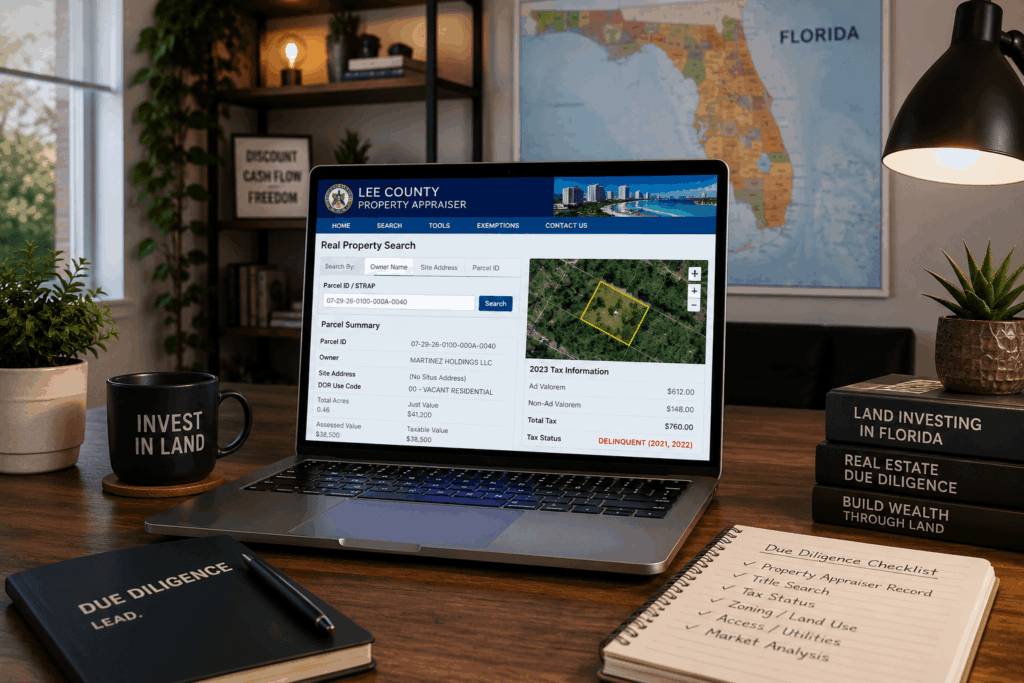
Every Florida county publishes full ownership and valuation records for every parcel in its jurisdiction — free, publicly searchable, and updated regularly. Most buyers glance at the address and the assessed value and move on. Investors who actually know how to read these records find information that changes their offer before they ever contact the seller.
What a property appraiser record actually is
The county property appraiser is a Florida constitutional officer responsible for determining the assessed value of every parcel for ad valorem tax purposes. The records maintained by this office are not the same as a title search they do not reveal liens, judgments, or encumbrances but they contain a dense layer of information that a serious buyer should review before making any offer on vacant land.
The record is publicly accessible through each county’s property appraiser website. Search by owner name, parcel ID number, or address. What comes back is a structured file that covers ownership, valuation, land classification, and tax history — all in one place, at no cost.
FLORIDA COUNTY PROPERTY APPRAISER PARCEL RECORD Illustrative example only
Ownership & Identification
Parcel ID (STRAP): 07-29-26-0100-000A-0040
Owner of Record: MARTINEZ HOLDINGS LLC
Mailing Address: 8400 NW 36TH ST, DORAL FL 33166
Owner Since: 2019 (5 years)
What to look for: Is the owner an individual or an LLC? A mailing address far from the parcel often indicates an absentee investor — potentially more motivated to sell. Note how long they have owned it; long-term owners may have more flexibility on price.
Valuation
Just (Market) Value: $41,200
Assessed Value: $38,500
Taxable Value: $38,500
Listed Asking Price: $72,000
What to look for: The county’s Just Value is the appraiser’s estimate of market value. It is not precise, but a listing price that is 75% above Just Value is a signal worth investigating before you anchor to the seller’s number.
Land Classification & Use
DOR Land Use Code00: Vacant Residential
Zoning RS-1: Single Family
Total Acreage: 0.46 acres
Frontage: 75 ft
What to look for: The DOR code tells you how the state classifies the land for tax purposes. Code 00 means the appraiser sees it as vacant and undeveloped. If the seller claims agricultural use or a different classification, the code should reflect that.
Tax History
2023 Ad Valorem Tax: $612
Non-Ad Valorem: $148
Total 2023 Tax Bill: $760
Tax Status: DELINQUENT 2021, 2022
What to look for: Delinquent taxes are a critical finding. They survive the sale and become your obligation at closing unless negotiated otherwise. Two years of delinquency in Florida also triggers the tax certificate process — which can eventually lead to a tax deed action.
The six fields that matter most for land investors
1. Just Value vs. asking price
The county’s Just Value is the appraiser’s estimate of what the parcel would sell for in an arm’s-length transaction. It is calculated from comparable sales, not from what the seller wants. It is not a precise appraisal, and it can lag the market — but a listing price that significantly exceeds Just Value deserves scrutiny.
Pull the Just Value before you look at the asking price. It gives you an independent anchor that has nothing to do with the seller’s expectations.
2. Ownership history and duration
How long has the current owner held the parcel, and what did they pay for it? Some county records show prior sale prices directly. Others require a search of official records. Either way, an owner who paid $8,000 for a lot in 2015 and is now asking $55,000 has a very different cost basis than one who paid $48,000 last year.
Ownership duration also signals motivation. A parcel that has changed hands three times in five years tells a different story than one held by the same LLC for a decade.
Potential leverage signal
Long-term owner, low cost basis, out-of-state mailing address — likely an absentee investor with flexibility on price and terms.
Caution signal
Recent purchase at or near current asking price — seller has limited room to negotiate and may be testing the market.
3. DOR land use code
The Florida Department of Revenue assigns a two-digit code to every parcel that classifies how the land is used for tax purposes. These codes appear on every property appraiser record and tell you a lot about how the state views the parcel:
Common DOR codes for land
00: Vacant residential
01–09: Single family / mobile home
50: Improved agricultural
60–69: Grazing / timber / misc. agriculture
99: Acreage, not agriculture
Why this matters
A parcel classified as agricultural (codes 50–69) may qualify for a Greenbelt tax exemption — meaning current taxes are artificially low. If you change the use, the tax bill increases and a rollback penalty may apply.
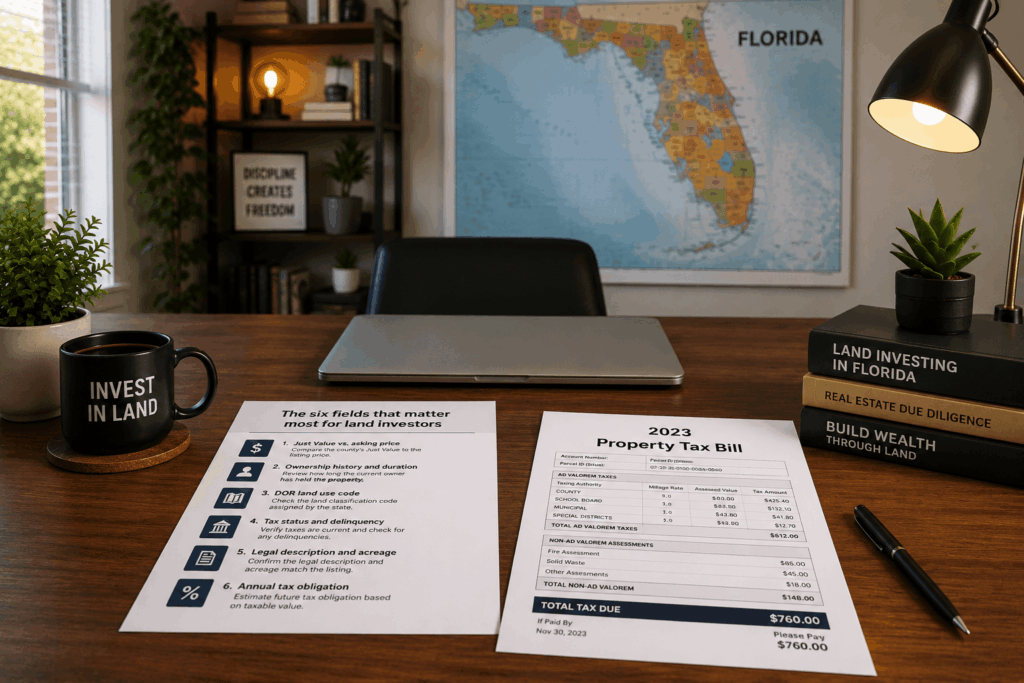
4. Tax status and delinquency
This is the field most buyers skip and most regret skipping. Delinquent property taxes in Florida do not disappear at closing. They attach to the parcel and transfer to the new owner unless explicitly resolved at settlement.
In Florida, unpaid taxes result in the issuance of a tax certificate after April 1 of the following year. If certificates go unredeemed for two years, the certificate holder can apply for a tax deed — which initiates a process that can ultimately result in the county auctioning the property out from under the title owner.
Always check tax status before making an offer. If the record shows delinquent taxes, calculate the full amount owed — including interest and fees — and factor it into your offer or require the seller to resolve it at closing as a condition of sale.
5. Legal description and acreage
The legal description on the appraiser record is the official description of the parcel boundaries — lot number, block, subdivision, or metes and bounds reference. This is what gets recorded on the deed. Verify that the legal description in any purchase agreement matches exactly what appears in the public record.
Acreage discrepancies between the listing and the appraiser record are common on rural parcels with older surveys. A parcel listed as “approximately 2.5 acres” that the appraiser records as 1.87 acres is a material difference — and it changes your per-acre price calculation.
6. Annual tax obligation going forward
The tax bill on the record reflects the current owner’s situation, which may include exemptions or special classifications that do not transfer to you. Calculate your expected annual tax obligation based on the taxable value shown — and add it to your carrying cost model before you finalize your offer.
For rural parcels with Greenbelt classification, get clarity before closing on whether you intend to maintain the agricultural use. Losing Greenbelt status triggers a tax rollback of up to three years plus current year taxes — a material and often unexpected cost.
How to access the record for any Florida county
Every Florida county maintains its own property appraiser website. Search for the county name plus “property appraiser” — most have a parcel search tool accessible without registration.
| Lee County leepa.org | Putnam County putnam-fl.com/pa | Marion County pa.marion.fl.us |
| Alachua County acpafl.org | Polk County polkpa.org | Highlands County hcpafl.org |
To find any county: search “[County Name] Florida property appraiser” — the official site will appear. All 67 Florida counties are required to maintain publicly accessible parcel records. You do not need an account, and access is free.
What the appraiser record does NOT tell you
The property appraiser record is a starting point, not a complete due diligence file. Before closing on any parcel, you need information that this record does not contain:
- Liens, judgments, or mortgages against the property — requires a title search through official records
- Exact boundary locations — requires a licensed surveyor; the record shows dimensions but not physical markers
- Wetlands classification and Army Corps jurisdiction — requires a separate environmental review
- FEMA flood zone designation — check msc.fema.gov using the parcel coordinates
- Zoning permitted uses beyond the classification code — verify directly with the county planning department
- Access easements and road frontage legality — requires a title search and sometimes a survey
- Utility availability at the parcel boundary — confirm with county utilities or the relevant provider
The appraiser record is free and available in minutes. These additional steps cost more and take longer — but they are what separates a purchase from a bet.
Pre-offer workflow: how to use this in practice
Here is the sequence a prepared investor follows before submitting any offer on a Florida land parcel:
1. Pull the parcel record from the county appraiser website
Use the parcel ID from the listing, or search by address. Download or screenshot the full record.
2. Note the Just Value and compare it to the asking price
This is your independent baseline. A large gap does not automatically mean the listing is overpriced — but it means you need to understand why before you offer.
3. Check the tax status line explicitly
Look for “delinquent,” “tax certificate issued,” or any unpaid balance. If you see any of these, get the exact amount owed before proceeding.
4. Note the DOR code and check for Greenbelt classification
If the parcel carries an agricultural classification, confirm whether the current tax rate reflects a Greenbelt reduction and what the rollback exposure is.
5. Verify the legal description and acreage against the listing
Any discrepancy between the listing description and the official record should be resolved before you make an offer — not after.
6. Pull closed sales from the same county appraiser records
Use the appraiser’s sales search tool to find parcels of similar size, classification, and location that have actually closed in the past 12 months. These are your real comparables.
This entire workflow takes 20–30 minutes and costs nothing
The buyer who reads the record makes the better offer
Most sellers on Land By Owner are transacting directly — no listing agent filtering your questions or managing your access to information. That transparency is an advantage you can use. The property appraiser record gives you a factual foundation before you ever speak with a seller: what the county thinks the land is worth, what the owner paid and when, what the taxes are and whether they are current, and how the state classifies the parcel.
Buyers who do this step come to the negotiation with data. Buyers who skip it come with assumptions. In a direct transaction, the difference is visible immediately.