

Most land investors know what they paid for a parcel and what they hope to sell it for. Few actually model what happens between those two numbers. That gap — carrying costs, financing drag, liquidity risk, zoning constraints — is where deals that looked profitable on paper stop performing. Here is how to run a real ROI analysis before you commit capital.
Start with the right formula then stress-test it
ROI in land investing is not complicated in principle. What makes it difficult is that most of the inputs are underestimated, ignored, or optimistically projected. The formula itself is straightforward:
ROI = ( Net Profit / Total Investment ) × 100
Net profit = gross sale price minus total cost basis
Total investment = every dollar deployed, not just the purchase price
The discipline is in building an honest total investment figure. Run your base case, then run a stress case: what does your ROI look like if the holding period doubles, costs come in 20% over budget, or the resale market softens? If the stress case is unacceptable, the base case is not as strong as it looks.
True cost basis: everything that goes into the denominator
The purchase price is the starting point, not the total investment. Every item below hits your denominator and reduces your ROI — and most are non-negotiable line items, not optional expenses.
| Cost item | Notes |
| Purchase price | Negotiate hard — every dollar saved here directly improves ROI at exit |
| Closing costs and title | Title search, owner’s policy, recording fees. Budget 2–4% of purchase price |
| Annual property taxes | No homestead exemption on vacant land — multiply by expected holding years |
| Survey and due diligence | Boundary survey, environmental review, wetlands determination. Budget $1,500–$4,000 |
| Utility and infrastructure | Well/septic or municipal connections can add $15,000–$40,000 before development begins |
| Financing costs | Total interest over the hold period, origination fees, prepayment terms — model precisely |
| Development and permitting | Impact fees, permits, site prep. Often the largest line item on development plays |
| Exit and marketing costs | Commissions, listing fees, closing costs at disposition |
Ignoring any of these creates an unrealistic profit picture and a distorted ROI projection.
A worked example: the numbers in practice
Here is a simplified model for a rural Florida parcel acquired for investment and resale. These are illustrative figures — not projections. Build your own model from verified inputs.
Illustrative model — rural Florida parcel, 3-year hold
| Cost basis | Return analysis | ||
| Purchase price | $28,000 | Projected resale (base) | $52,000 |
| Closing and title | $950 | Net profit | $14,510 |
| Survey and due diligence | $1,800 | Total ROI | 38.7% |
| Property taxes (3 yrs) | $1,200 | Annualized ROI | 11.5% |
| Seller financing interest | $5,040 | Stress resale (soft market) | $44,000 |
| Exit and listing costs | $500 | Stress net profit | $6,510 |
| Total investment | $37,490 | Stress ROI / annualized | 17.4% / 5.5% |
The stress case still produces a positive return — but notice that the annualized figure drops to 5.5%. That is the number to watch.
Holding period is where ROI quietly erodes
A 38% total return looks strong. A 38% return over eight years does not. Land is illiquid, and Florida markets move in cycles. The annualized ROI — not the headline total — is the number that tells you whether the opportunity is actually competitive with other uses of your capital.
| Scenario | Total ROI | Hold period | Annualized ROI |
| Base case | 38.7% | 3 years | 11.5% |
| Extended hold | 38.7% | 6 years | 5.3% |
That six-year scenario produces identical gross profit but delivers a return that barely outperforms a money market account — with substantially more capital locked up and risk exposure. Model the hold period honestly. Rural parcels with specific buyer profiles can sit longer than projected.
Seasonal note: Florida land typically absorbs faster in Q1 and Q4, when seasonal buyers are active in the market. If your exit timeline puts you selling in summer, build in a longer hold estimate when running your annualized return.
What to look for and what to avoid in the market
Location-specific demand drivers have more impact on Florida land ROI than broad statewide trends. These are the signals that matter at the parcel level:
Positive signals
- Active residential corridor expansion nearby
- Confirmed infrastructure projects — not rumored
- Zoning already supports intended use
- Utility access at or near the parcel boundary
- Multiple comparable closed sales within the past 12 months
- Low days-on-market for similar parcels locally
Red flags
- Appreciation assumptions based on unconfirmed future projects
- No recent comparable closed sales in the area
- Wetlands or flood zone covering significant lot area
- No legal access or deeded easement to the parcel
- Zoning does not support the intended use
- Seller pricing based on projected value rather than current market
Use county property appraiser websites to pull closed sales — not list prices, not automated valuation estimates. Closed transactions are the only data point that reflects what actual buyers paid.
How financing structure moves the ROI number
Cash buyers have a simpler calculation. Financed acquisitions require additional precision because every dollar of interest paid reduces net profit — and on longer holds, financing costs can materially compress the return.
Seller financing — available through Land By Owner for qualified entity buyers — often provides more favorable terms than conventional lending on land: lower down payment requirements, flexible payment schedules, and in some cases interest-only periods that reduce carrying costs during the holding phase. Structuring the financing correctly at acquisition is not a secondary consideration. It directly determines what your final ROI number is.
Model the financing component exactly: total interest paid over the expected hold period, balloon payment timing, and cash reserve requirements during the life of the note. The spread between seller financing terms and conventional lending can be significant — and that difference compounds materially over a multi-year hold.
Always model total interest cost over the full hold period — not just the monthly payment.
Zoning and legal constraints: the variables that can zero out a return
No ROI model survives a surprise zoning restriction. If you purchase a parcel intending to develop and discover post-closing that the land carries a wetland jurisdiction, a conservation overlay, or a utility easement that prevents construction — the financial analysis becomes irrelevant.
These are not rare edge cases in Florida. They are common enough that disciplined buyers treat zoning and environmental verification as a prerequisite to building any financial model — not a step that happens after an offer is accepted.
Before your numbers mean anything, confirm:
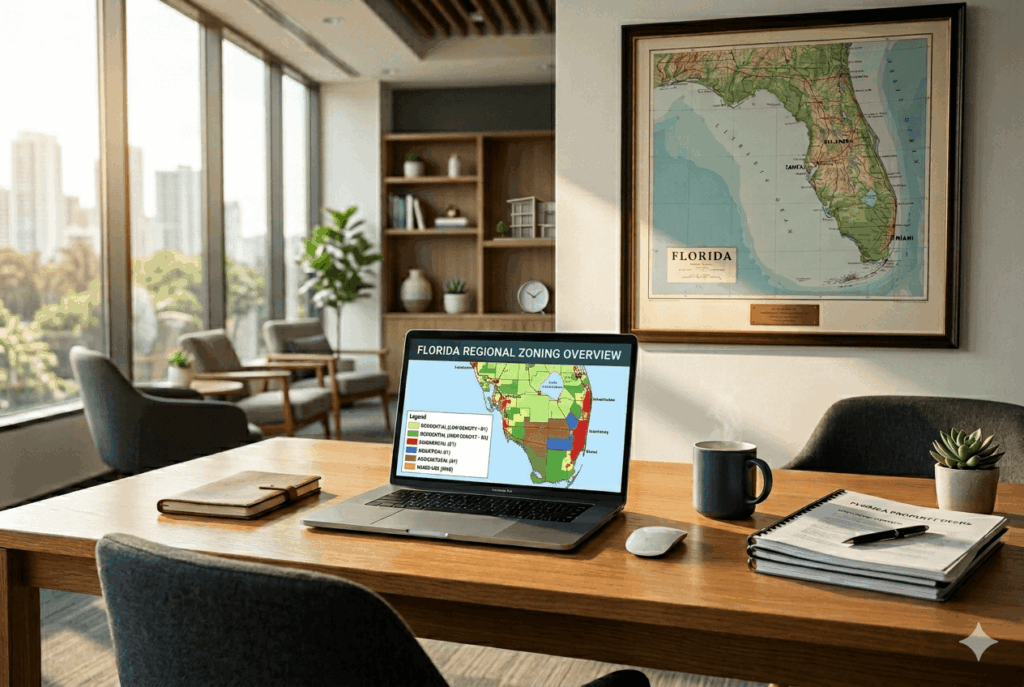
- Zoning classification and permitted uses (county planning department)
- Flood zone status via FEMA FIRM maps at msc.fema.gov
- Wetlands coverage and any Army Corps jurisdictional determination
- Legal access to the parcel via deeded easement or public road frontage
- Any deed restrictions or easements recorded against the title
Use the framework then make a decision
ROI analysis is a tool for making a decision, not a substitute for one. Some investors over-model to the point of paralysis. Others model nothing and rely on instinct. The discipline is building an honest, complete cost picture — including the stress case — and then deciding whether the risk-adjusted return justifies the capital deployment relative to other opportunities available to you.
At Land By Owner, buyers acquire directly from private sellers with no commission layer on the buy side. That structural cost advantage starts improving your ROI before the analysis even begins. If you are evaluating Florida land as a business investment, start with inventory priced without a middle layer.