
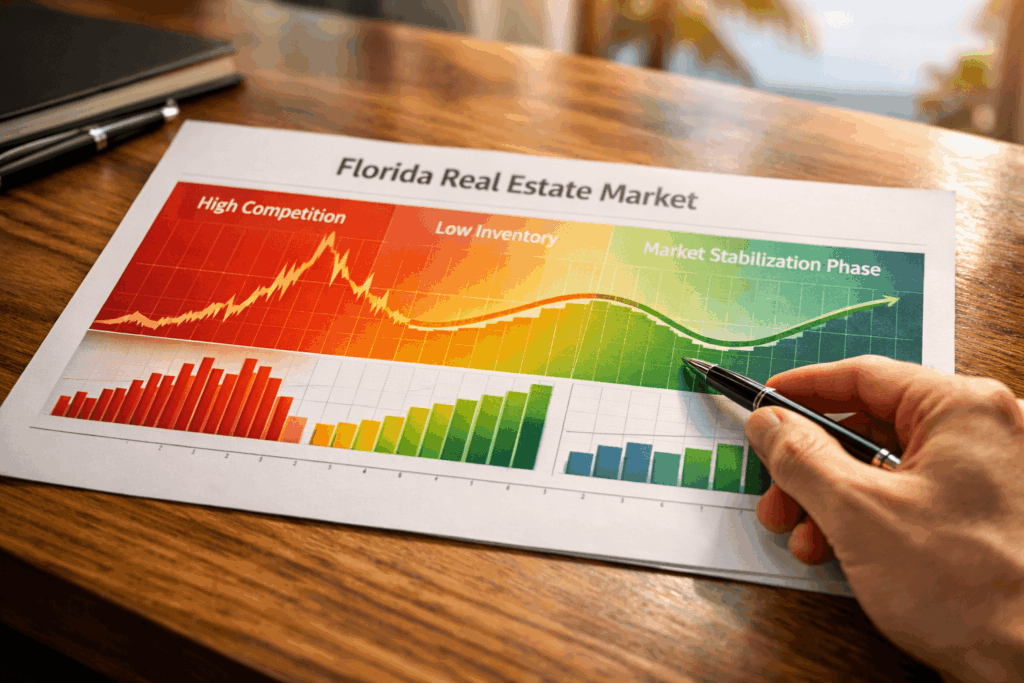
Florida’s real estate market is transitioning out of a period defined by rapid price acceleration, compressed inventory, and heightened competition. For land buyers, this shift marks a move away from volatility and toward a more stable, structured acquisition environment. Understanding this transition is critical for maintaining disciplined investment strategies and avoiding assumptions formed during prior market conditions.
Between 2020 and 2022, Florida experienced an atypical expansion cycle. Demand surged due to population inflows, remote work flexibility, and historically low borrowing costs. This environment contributed to accelerated pricing across both improved properties and vacant land, often outpacing fundamental valuation metrics. In many cases, acquisition decisions were driven by speed and competitive pressure rather than structured analysis.
The current market cycle reflects a recalibration.
Price growth has moderated across most regions, and inventory levels have begun to expand. For land buyers, this introduces a more balanced dynamic between supply and demand. Rather than navigating scarcity-driven bidding environments, buyers are now positioned to evaluate multiple opportunities with greater attention to underlying fundamentals.
This stabilization phase does not indicate market weakness. Instead, it represents normalization.
A key shift in the current environment is the increased importance of data-driven acquisition. During periods of volatility, rapid price movement can obscure risk. In contrast, a stable market allows for clearer analysis of variables such as comparable land sales, zoning constraints, access, and long-term usability.
Buyers should expect longer decision windows compared to prior years. While well-positioned properties continue to transact, the urgency associated with peak-cycle conditions has diminished. This creates an opportunity to apply consistent underwriting standards without the pressure to act reactively.
Another defining characteristic of the current cycle is cost sensitivity.
Holding land in Florida involves ongoing expenses, including property taxes, potential association requirements, and, in certain areas, environmental or flood-related considerations. During high-appreciation periods, these costs were often viewed as secondary to projected gains. In a stabilized market, they become central to acquisition decisions.
Disciplined buyers are now incorporating these factors into their initial evaluation rather than treating them as post-acquisition considerations.
Financing conditions also play a role in shaping the current landscape. While borrowing costs remain elevated relative to historical lows, they have shown signs of stabilization. This improved predictability supports more consistent deal structuring and reduces the uncertainty that previously impacted acquisition timing.
As a result, the focus shifts from attempting to “time” interest rates to ensuring that each acquisition aligns with defined investment criteria and risk tolerance.
For business-purpose land buyers, intent clarity is increasingly important.
The distinction between acquiring land for investment versus personal use must remain consistent across documentation, communication, and execution. A stabilized market environment reinforces the need for clearly defined acquisition strategies tied to long-term objectives rather than short-term speculation.
This is particularly relevant as regulatory scrutiny continues to emphasize the importance of transaction purpose and borrower profile consistency.
Geographic segmentation is another critical factor in today’s market.
Florida is not a uniform market, and conditions vary significantly by region. Some areas that experienced aggressive price expansion are undergoing localized corrections, while others continue to demonstrate steady demand supported by population growth and infrastructure development.
Buyers should avoid relying on statewide narratives and instead focus on submarket-level data. Factors such as access to utilities, road infrastructure, and proximity to growth corridors can materially impact land usability and long-term value.
This localized approach reduces reliance on generalized assumptions and supports more defensible acquisition decisions.
Importantly, expectations must adjust alongside market conditions.
The prior cycle conditioned many participants to anticipate rapid appreciation within short timeframes. In the current environment, such assumptions introduce unnecessary risk. Stabilization favors a longer-term perspective, where value realization is tied to strategic positioning rather than market momentum.
This does not diminish the viability of land as an asset class. Instead, it reinforces its role as a component of a broader, long-term portfolio strategy.
For sellers and operators, this shift also impacts how opportunities are presented.
Marketing language should remain aligned with current market realities, avoiding exaggerated claims or projections. Clear, accurate representations of property characteristics and potential use cases contribute to stronger transaction integrity and reduce the likelihood of post-sale disputes.
Consistency between marketing, buyer intent, and transaction structure is essential for maintaining compliance alignment.
Summary
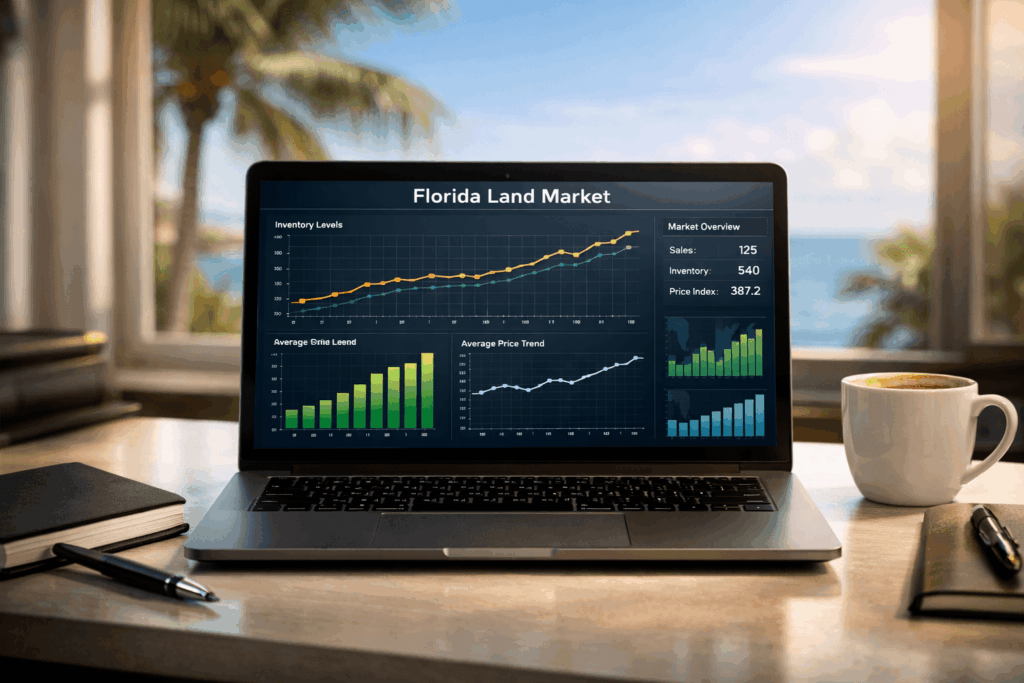
Florida’s land market is entering a phase defined by stability, increased inventory, and more measured pricing behavior. These conditions support a disciplined approach to acquisition, where data, cost awareness, and strategic alignment take precedence over speed and speculation.
Buyers who adapt to this environment—by prioritizing structured analysis, maintaining clear investment intent, and focusing on submarket fundamentals—are better positioned to navigate the current cycle effectively.
At Land By Owner, the emphasis remains on maintaining clear business-purpose positioning, consistent transaction documentation, and alignment between acquisition strategy and long-term portfolio objectives. As market conditions normalize, this structured approach becomes increasingly important for reducing ambiguity and maintaining compliance integrity.
Stability does not eliminate opportunity. It refines it.