

When you sign a Contract for Deed, you are not just buying land — you are committing to a defined payoff path. Understanding that path in detail, before you sign, is what separates buyers who close cleanly from buyers who hit avoidable complications at the finish line.
This article walks through the complete payoff process on a Land By Owner CFD transaction: how to request a payoff statement, what triggers the deed transfer, what fees apply, the timeline from final payment to recorded deed, and how early payoff works.
What “Payoff” Means on a Contract for Deed
On a traditional mortgage, payoff means sending a final payment to a lender who then releases their lien. The deed has been in your name since closing — payoff just removes the encumbrance.
On a Contract for Deed, payoff is different in a fundamental way: the deed has never been in your name. It has remained in the seller’s name throughout the payment period. Payoff is not lien release — it is the event that triggers the actual transfer of legal title from the seller to your LLC.
This distinction matters because:
- The deed transfer is a new legal act, not just a release of a recorded instrument
- It requires the seller to execute a new deed in your LLC’s name
- That deed must then be recorded at the county clerk’s office
- Only after recording does your LLC appear on the public record as owner
Every step of that sequence costs time and money. Know what to expect.
Step 1 — Request a Payoff Statement
You can request a payoff statement at any point during the contract term — at month 3 or month 57. You do not have to wait until the scheduled end of the contract.
How to request it: Contact IRONBRIDGE PAYMENT ADMINISTRATION LLC through the GeekPay servicer portal or by the contact method specified in your contract. Request a payoff statement as of a specific date — typically 15 to 30 days out to give yourself time to wire funds.
What the payoff statement contains:
- Remaining principal balance as of the statement date
- Per-diem interest accrual (how much interest accumulates per day after that date)
- Any outstanding late fees or returned payment fees
- The exact wire amount required to pay off in full
- Wire instructions
- Statement expiration date (payoff figures are only valid as of the stated date)
Critical: Do not wire funds based on an informal balance estimate. Always obtain a formal payoff statement with a specific good-through date. If your wire arrives after the expiration date, you may owe additional per-diem interest.
Step 2 — Wire the Payoff Amount
Send the exact amount specified in the payoff statement to the wire instructions provided by IRONBRIDGE PAYMENT ADMINISTRATION LLC.
Important protocol:
- Wire from your LLC’s bank account, not a personal account
- Include the property parcel number or contract reference number in the wire memo
- Retain your wire confirmation as a permanent record
- Notify the servicer by email or through the portal that the wire has been sent and provide the confirmation number
Do not send a check. Do not use ACH for a payoff if the contract specifies wire transfer. A payment method mismatch can delay the process.
Step 3 — Servicer Confirms Receipt and Notifies the Seller
Once the payoff wire is received and confirmed by IRONBRIDGE PAYMENT ADMINISTRATION LLC, the servicer:
- Applies the payment to zero out the remaining balance
- Generates a payoff confirmation
- Notifies Stronghold Real Estate LLC (the seller/title holder) that the contract has been satisfied
This step typically completes within 1–3 business days of wire receipt confirmation.
Step 4 — Seller Executes the Deed
Stronghold Real Estate LLC then prepares and executes a deed transferring the property to your LLC. The deed type used is typically a Warranty Deed or Special Warranty Deed — your contract specifies which type you are entitled to receive.
What goes on the deed:
- Grantor: Stronghold Real Estate LLC
- Grantee: Your LLC (exact legal name as it appears on your operating agreement and EIN documentation)
- Legal description of the parcel (identical to the description in your Contract for Deed)
- Consideration recited
Why the grantee name must be exact: If your LLC name on the deed does not match your LLC’s legal name as registered with the state, the deed is defective. This is a real error that happens when buyers informally shorten their LLC name on purchase documents. Use the full legal name — including “LLC,” “L.L.C.,” or “Limited Liability Company” — exactly as registered.
Step 5 — Deed Is Recorded at the County Clerk’s Office
The executed deed is sent to the county clerk’s office in the county where the property is located for recording. Recording is the act that makes the transfer official in the public record.
Recording fees vary by county but are typically $10–$20 for the first page plus $8.50 per additional page. Documentary stamp tax (doc stamps) also applies:
Florida documentary stamp tax on deeds: $0.70 per $100 of consideration
On a $28,000 payoff, doc stamps would be approximately $196. Your contract or closing documents should specify who is responsible for doc stamps at payoff — typically the buyer, consistent with how doc stamps were handled at the original closing.
Timeline from deed execution to recording: 3–7 business days in most Florida counties. Some counties offer e-recording which can complete in 1–2 business days.
Step 6 — You Receive the Recorded Deed
Once recorded, the clerk’s office returns the deed (with a recorded stamp, book and page number, and recording date) to the party who submitted it for recording. The servicer or seller then forwards the recorded deed to your LLC.
What you do with the recorded deed:
- Store the original in a secure location (fireproof safe, safe deposit box, or with your attorney)
- Make a digital scan and store it in your entity records
- The deed serves as your proof of ownership for all future purposes: financing applications, title searches, resale, estate planning
At this point, a title search on the parcel will show your LLC as owner of record. The CFD transaction is complete.
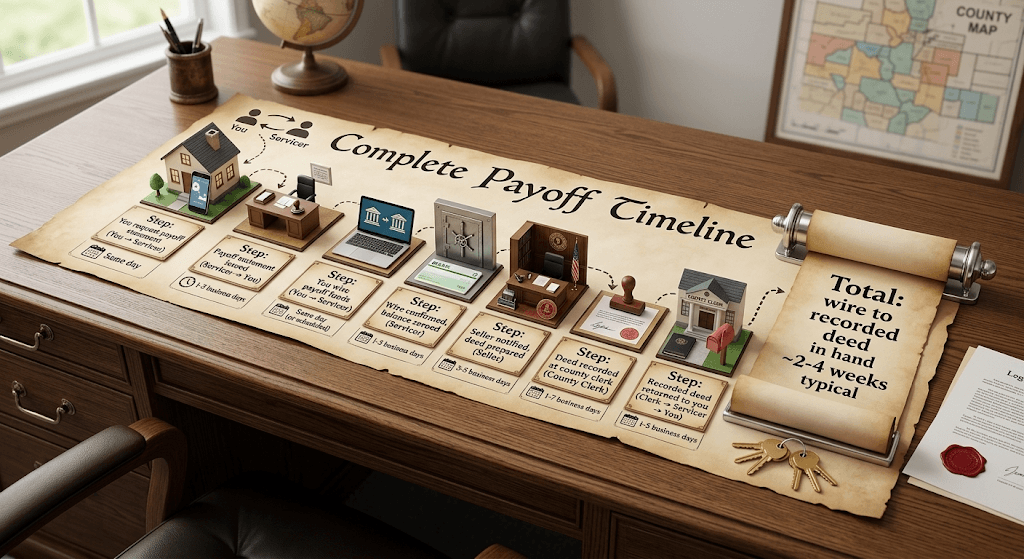
Complete Payoff Timeline
| Step | Who Acts | Typical Timeframe |
| You request payoff statement | You → Servicer | Same day or next business day |
| Payoff statement issued | Servicer → You | 1–3 business days |
| You wire payoff funds | You → Servicer | Same day as statement receipt (or scheduled) |
| Wire confirmed, balance zeroed | Servicer | 1–3 business days after wire receipt |
| Seller notified, deed prepared | Seller | 3–5 business days |
| Deed executed and sent for recording | Seller/Title | 1–3 business days |
| Deed recorded at county clerk | County Clerk | 1–7 business days |
| Recorded deed returned to you | Clerk → Servicer → You | 1–5 business days |
| Total: wire to recorded deed in hand | ~2–4 weeks typical |
This timeline assumes no complications. Complications that add time: incorrect LLC name on the deed (requires correction and re-execution), doc stamp dispute, county clerk backlog, or wire received after payoff statement expiration date.
Early Payoff — How It Works
Nothing in Florida law prohibits early payoff on a Contract for Deed unless the contract itself contains a prepayment penalty clause. Review your contract for a prepayment penalty provision before assuming you can pay off early without cost.
Land By Owner CFD contracts do not include prepayment penalties. You may pay off the remaining balance at any time after the first payment, following the same process described above.
Why early payoff matters strategically:
If you plan to resell the parcel before the contract term ends, you typically need legal title — either to execute a deed to the new buyer, or to qualify the parcel for conventional financing the buyer may be seeking. Early payoff gives you legal title, which gives you full flexibility on exit.
If you plan to develop the parcel and pull building permits, you need legal title. Most Florida counties will not issue permits to a party who holds only equitable interest. Early payoff clears that constraint.
What Happens If the Seller Refuses to Execute the Deed
This is the question buyers ask when they first understand how a Contract for Deed works — and it is a fair one. The deed is in the seller’s name. What if the seller simply does not cooperate at payoff?
Florida law provides a remedy: specific performance. When you have satisfied all obligations under a Contract for Deed, you have a legally enforceable right to receive the deed. A court can order the seller to execute it, or order that a judicial deed be issued in lieu of the seller’s execution.
This remedy is well-established in Florida. It is also why recording a memorandum of the Contract for Deed (or the CFD itself) at the outset of the transaction matters — it creates a public record of your equitable interest that survives any subsequent claims against the seller.
At Land By Owner, the seller entity is Stronghold Real Estate LLC, and the payoff and deed transfer process is administered through a third-party servicer specifically to provide procedural accountability at this step.
Payoff vs. Selling Your Interest Mid-Contract
Payoff is not the only exit. If you want to exit the investment before the contract term ends and before payoff, you have two options depending on your contract terms:
1. Assignment of the contract: Transfer your buyer’s position (equitable interest) to a new buyer. The new buyer steps into your place and continues making payments. Requires seller consent if your contract restricts assignment (most do).
2. Sale of LLC interest: If the parcel is held in a single-purpose LLC, selling membership interest in the LLC transfers control of the asset without touching the CFD. This is sometimes cleaner than assignment because it does not require seller consent — the LLC ownership changes, but the LLC’s position in the CFD remains unchanged.
Both approaches require legal structuring and title company coordination. Neither is simple for a first-time investor. If your exit strategy depends on a mid-contract sale, discuss it with a Florida real estate attorney before closing.
Pre-Signing Payoff Checklist
Before you sign a Contract for Deed, confirm the following payoff-related terms in the document:
- [__] Deed type you will receive at payoff (Warranty Deed or Special Warranty Deed)
- [__] Who is responsible for recording fees and doc stamps at payoff
- [__] Whether a prepayment penalty exists and its terms
- [__] Assignment rights — can you transfer your interest without seller consent?
- [__] Payoff statement request procedure and response timeframe
- [__] Whether a memorandum of the CFD will be recorded at closing
The Bottom Line
The payoff process on a Contract for Deed is mechanical — request statement, wire funds, receive deed. The timeline from final payment to recorded deed runs approximately 2–4 weeks under normal conditions. The complexity is not in the process itself but in getting the details right: exact LLC name on the deed, correct wire amount with a valid payoff date, and doc stamps calculated and paid correctly.
Buyers who understand this process in advance close cleanly. Buyers who discover it at payoff scramble.
.