
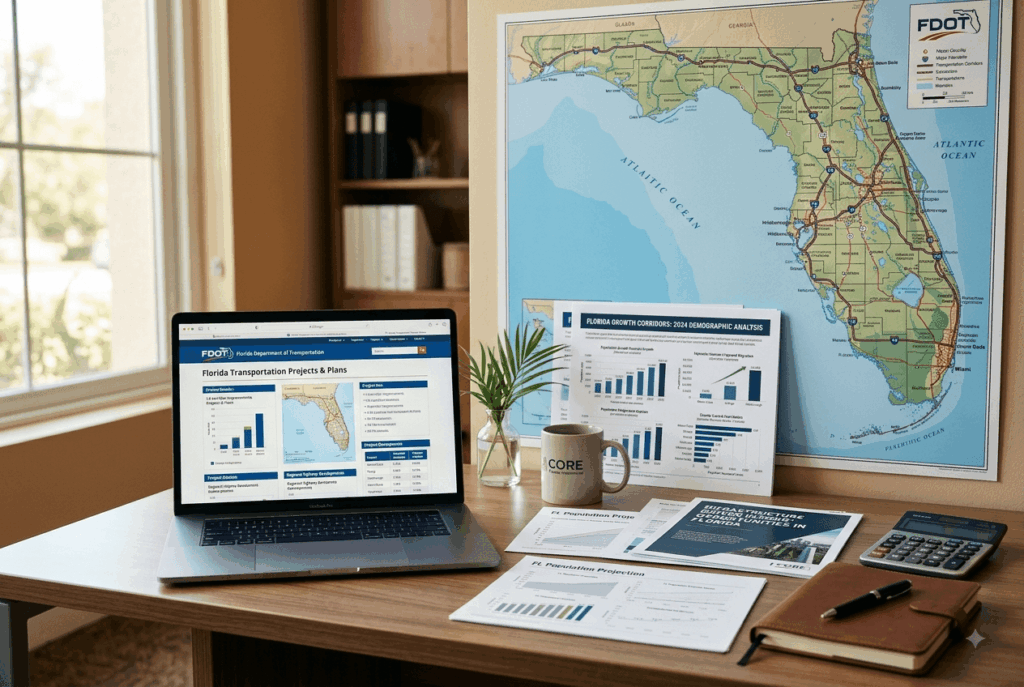
Florida added more residents than any other state for two consecutive years after 2020 — and while growth has moderated from that peak, the structural migration trend has not reversed. For rural land investors, the relevant question is not whether Florida is growing. It is where growth is spilling, at what pace, and whether those locations translate into real demand for undeveloped parcels. The answer requires going beyond the headline numbers.
What the numbers actually show
Florida’s population growth over the past five years has been driven primarily by domestic migration — residents relocating from high-cost states, particularly New York, California, Illinois, and New Jersey — rather than international immigration or natural increase. This matters for land investors because domestic migrants tend to be working-age adults with capital, employment flexibility, and a preference for less dense living environments than what they left behind.
The U.S. Census Bureau’s most recent estimates put Florida’s population above 23 million, with annual net in-migration continuing despite a post-2022 moderation from the pandemic-era peak. County-level growth reports show the expansion is geographically distributed — not concentrated exclusively in Miami-Dade, Broward, and Palm Beach.
| 23M+ | Florida population, 2024 est |
| #1 | Net domestic migration, 2021–2022 |
| 300K+ | Net new residents per year, recent average |
| 45 of 67 | Florida counties showing positive growth |
Population growth is a lagging indicator for rural land demand — not a leading one. The link between new residents and demand for undeveloped parcels runs through infrastructure investment, zoning changes, and employment growth, not directly through headcount. A county adding 5,000 residents per year may or may not translate into near-term land demand depending on where those residents settle and what infrastructure already exists.
How growth actually reaches rural land — the four mechanisms
Population growth does not flow directly to rural parcels. It moves through a chain of cause and effect that investors need to understand to distinguish genuine demand signals from noise.
1. Urban core saturation pushes buyers outward
When coastal and urban markets become unaffordable or oversaturated, buyers — both residential and commercial — move to adjacent counties. This is how Osceola absorbed overflow from Orange, how St. Johns absorbed overflow from Duval, and how Lee County absorbed overflow from Collier. The rural land adjacent to these secondary markets is the next ring in the expansion.
2. Infrastructure investment precedes development
Road expansions, utility line extensions, and new interchange construction signal where development is being planned — often years before it materializes. FDOT’s Five-Year Work Program and county capital improvement plans are public documents that show where the state and counties are committing infrastructure investment. Land adjacent to planned improvements typically absorbs demand earlier than land without them.
3. Employment centers create satellite residential demand
Major employers relocating to or expanding in Florida — logistics hubs, distribution centers, manufacturing facilities — create commuter-range demand for workforce housing and supporting land. Workers who cannot afford proximity to the employment center look 30 to 60 minutes out. That radius often includes rural land with road access and near-term utility availability.
4. Remote work decouples residence from employment
The sustained growth in remote and hybrid work has made rural Florida viable for workers who previously needed proximity to an office. This has increased demand for parcels with off-grid potential, agricultural zoning, and recreational access — categories that had limited buyer pools before 2020. That buyer pool is now meaningfully larger.
The corridors where this is actually happening
Not every Florida county benefits equally from statewide population growth. These are the corridors where the spill-out from major metros is creating measurable rural land demand — not speculation, but documented growth patterns in county planning records and property transaction data.
I-4 Corridor: Polk, Osceola, Volusia
High activity
Connecting Tampa and Orlando, the I-4 corridor has absorbed sustained growth pressure from both anchoring metros. Polk County in particular has seen significant residential and industrial development. Rural parcels in the eastern and southern parts of these counties are within commuting range of major employment centers while remaining meaningfully below coastal pricing.
Northeast FL: St. Johns, Putnam, Flagler
High activity
Jacksonville’s growth has compressed St. Johns County pricing, pushing buyers into Putnam and Flagler. Both counties remain affordable while sitting within 45 to 60 minutes of Jacksonville’s employment base. Putnam’s lake-adjacent parcels and Flagler’s coastal adjacency support recreational and residential demand from a broadening buyer pool.
Southwest FL: Charlotte, Hendry, Glades
Moderate activity
Lee County pricing post-Ian has pushed buyers into Charlotte County and inland toward Hendry and Glades. Infrastructure in Hendry and Glades remains thin — this is a longer-horizon corridor. Charlotte County’s proximity to Fort Myers and Punta Gorda employment creates more near-term demand, particularly for agricultural and rural residential zoning.
North Central FL: Marion, Levy, Citrus
Moderate activity
Ocala’s growth as a logistics and equine industry hub has strengthened Marion County’s land market. Levy and Citrus remain more rural with thinner demand — recreational buyers and long-horizon investors are the primary audience. Gainesville’s university employment creates some secondary demand in the eastern portions of Levy County.
What population growth does — and does not — mean for a specific parcel
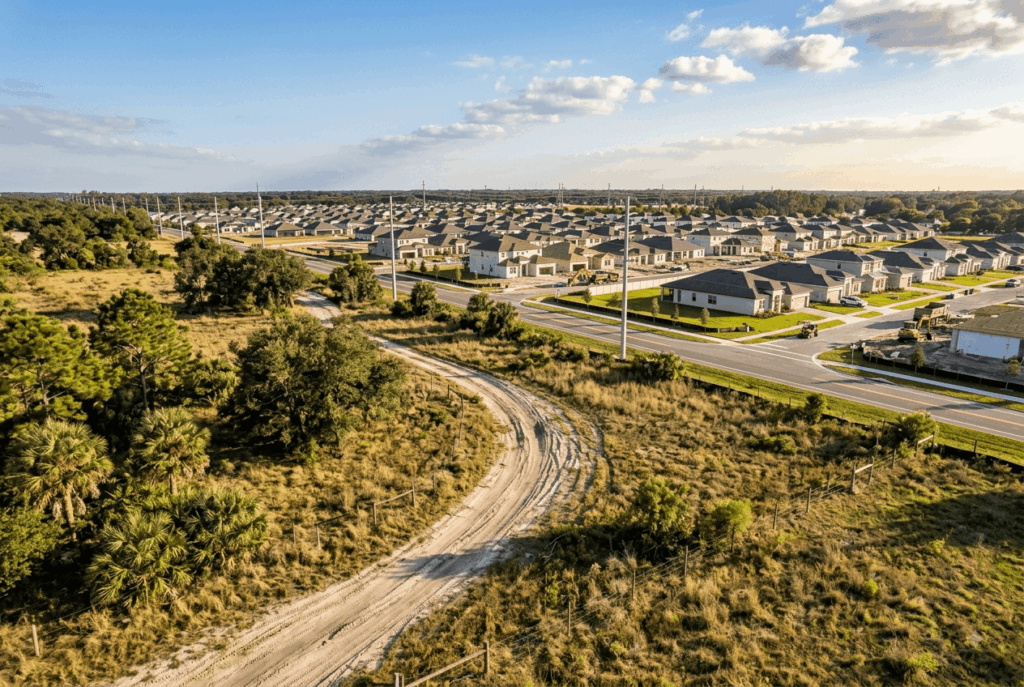
County-level growth statistics are useful context. They are not a substitute for parcel-level analysis. A county adding 10,000 residents per year can simultaneously contain thousands of parcels with no viable path to development due to wetlands, flood zone, infrastructure absence, or restrictive zoning.
What growth signals support
- Long-term appreciation thesis in counties within commuting range of employment
- Broader buyer pool for rural residential and agricultural parcels
- Infrastructure investment cycles that improve parcel utility over time
- Seller-financed resale demand from buyers priced out of improved property
- Recreational land demand from remote workers relocating to Florida
What growth does not guarantee
- Near-term appreciation on any specific parcel
- Development feasibility — zoning, wetlands, access still determine this
- Resale liquidity — rural land moves slowly regardless of county growth
- Infrastructure reaching a specific parcel on any defined timeline
- Demand from the growth trend reaching your exit window
The most reliable use of population data in land investing is to eliminate counties — not to select parcels. If a county is losing population, infrastructure investment is declining, and employment is contracting, the macro environment works against you regardless of parcel quality. If a county is growing, the environment is supportive — but parcel-level due diligence still determines whether a specific acquisition makes sense.
The data sources that matter — and how to use them
Generic references to “U.S. Census data” are not actionable. These are the specific sources that produce usable signals for rural land investors in Florida, and what to look for in each:
| Data source | What to look for | Signal strength |
| U.S. Census Bureau — County Population Estimates (released annually) | Net domestic migration by county year-over-year. Absolute growth numbers matter less than the trend direction and whether growth is accelerating or decelerating. | Strong — use for county selection |
| Florida Office of Economic and Demographic Research (edr.state.fl.us) | County population projections through 2045. More granular than Census estimates and Florida-specific. Shows which counties are projected to grow most aggressively over a 10–20 year horizon. | Strong — use for long-horizon positioning |
| FDOT Five-Year Work Program (fdot.gov) | Planned road expansions, interchange improvements, and new construction by county. This is where infrastructure investment is being committed — which shapes where development follows. | Strong — use for corridor identification |
| County Comprehensive Plan / Future Land Use Map | How the county plans to zone and develop land over the next 10–20 years. Future Land Use designations that differ from current zoning indicate where the county expects growth to occur. | Moderate — directional, not a guarantee |
| County Property Appraiser — Closed Sales Search | Actual transaction volume and price trends for vacant land in specific zip codes. This is the only data source that reflects real buyer behavior — not projections. | Strong — use for parcel-level pricing |
| Realtor.com / Zillow days-on-market for vacant land | How quickly comparable parcels are selling in the target area. Not precise, but useful for gauging whether buyer demand is active or dormant at current price points. | Moderate — directional only |
| Statewide or national real estate headline data | Florida home prices up 4%, national housing market trends, etc. | Weak — too aggregated to be useful for rural land decisions |
Translating demographic signals into an acquisition decision
Here is how a disciplined investor uses population data in the acquisition process — not as a reason to buy, but as one filter in a multi-step evaluation.
- Confirm the target county shows positive net domestic migration trend over the past 3–5 years (Census Bureau county estimates)
- Verify the county has active infrastructure investment in or near the target area (FDOT Five-Year Work Program)
- Check the county’s Future Land Use Map — confirm the parcel or adjacent area is not designated conservation or agricultural-only in the long-term plan
- Pull closed sales from the county property appraiser for comparable parcels in the past 12 months — confirm active transaction volume, not stagnant inventory
- Verify parcel-level constraints: flood zone, wetlands, zoning, legal access, utility availability
- Model your exit — who is the realistic buyer, on what timeline, and does the population trend support that buyer pool being active when you need to sell
Population data eliminates weak counties — it does not select parcels
Growth is the context — the parcel is the decision
Florida’s demographic trajectory remains one of the strongest in the country for rural land investors — not because every parcel will appreciate, but because the macro environment continues to generate buyer demand across a broader geographic range than it did five years ago. Remote work, urban saturation, and sustained domestic migration have expanded the viable buyer pool for rural Florida land in ways that are durable, not cyclical.
That context does not replace parcel-level due diligence. It informs where to look and which corridors to prioritize. At Land By Owner, private sellers list parcels direct — no commission layer, seller financing available to qualified entity buyers. If a county’s demographic trend puts it on your radar, the parcel-level evaluation starts with the listings.
.