
Land transactions in Florida come with a vocabulary that most buyers encounter mid-deal — when they are least equipped to slow down and verify what a term actually means. This glossary covers the 40 terms that appear most frequently in Florida vacant land transactions, organized by category. Bookmark it before you make your first offer.
Title & Ownership
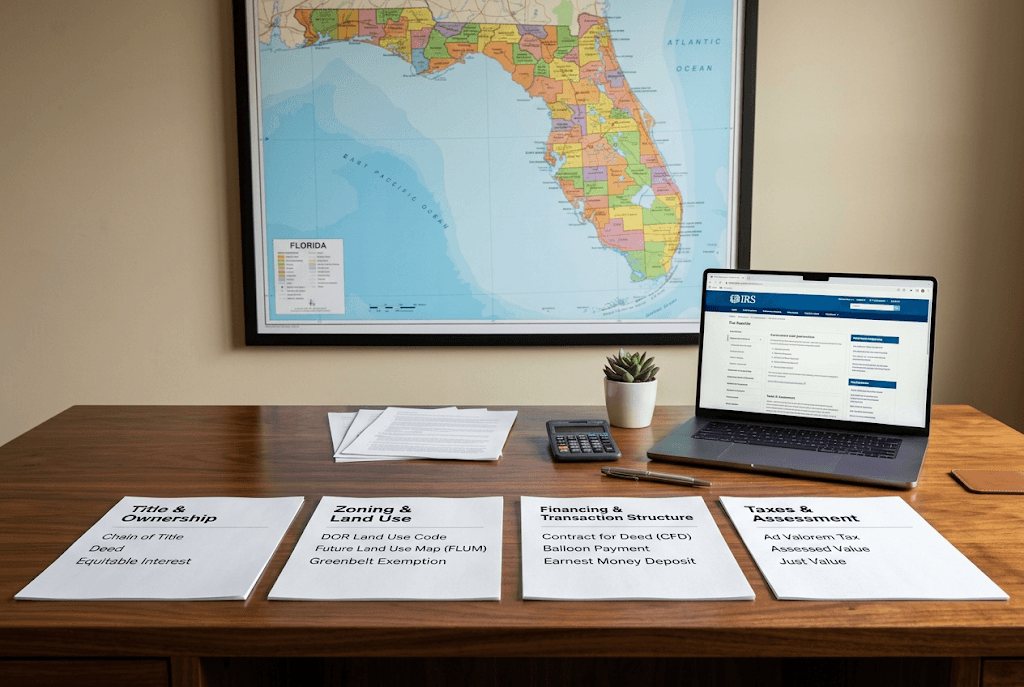
Chain of Title
The complete sequential history of ownership transfers recorded for a parcel, from the original grant to the current owner. A clear chain of title means every transfer is documented and unbroken. Gaps in the chain — missing deeds, unrecorded transfers, or missing heirs — create title defects that must be resolved before a clean transfer can occur. Why it matters: A broken chain is not cosmetic — it can prevent a title company from insuring the transaction and create legal disputes years after closing.
Deed
The legal instrument that transfers ownership of real property from one party to another. In Florida land transactions, three deed types are common: a Warranty Deed (seller warrants title against all prior claims), a Special Warranty Deed (seller warrants title only against claims arising during their ownership period), and a Quitclaim Deed (transfers whatever interest the grantor has, with no warranties). Land By Owner transactions typically use a Special Warranty Deed. Why it matters: The deed type tells you how much protection you have against title claims that pre-date your purchase.
Equitable Interest
The contractual right to receive legal title upon fulfilling the terms of a financing agreement, even though the seller retains legal title in the interim. In a Contract for Deed, the buyer holds equitable interest — not legal title — throughout the payment period. Equitable interest gives the buyer enforceable rights to the property but does not allow permit-required construction until legal title transfers. Why it matters: On a seller-financed transaction, you do not own the property in the same way a mortgage buyer does — understanding this distinction prevents operational surprises.
Lis Pendens
A recorded legal notice indicating that a lawsuit has been filed affecting a specific parcel of real property. Latin for “suit pending.” A lis pendens appears in the title search and signals that the property is subject to active litigation — which clouds the title and can prevent or delay closing until the suit is resolved. Why it matters: A lis pendens is one of the red flags that makes a title company refuse to insure a transaction. Always confirm resolution before closing.
Lien
A legal claim against a property as security for a debt or obligation. Common types on Florida land: property tax liens, contractor/mechanic’s liens, HOA assessment liens, and judgment liens. Liens attach to the property — not just the owner — and generally must be satisfied before title can transfer cleanly. Why it matters: A lien discovered in the title search that the seller refuses to resolve is a deal-stopper or a negotiating point, not an administrative detail.
Owner’s Title Insurance
A one-time premium paid at closing that insures the buyer against future title defects not discovered during the title search — forged signatures on prior deeds, undisclosed heirs, recording errors, and similar claims. Distinct from lender’s title insurance, which only protects the lender. The cost is a small percentage of the purchase price and protects the buyer’s ownership for as long as they hold the property. Why it matters: A title search catches what is recorded. Owner’s title insurance covers what the search missed. Both are necessary.
Quiet Title Action
A Florida court proceeding used to resolve disputes over property ownership and establish clear title. Common scenarios: missing heirs, tax deed history, or breaks in the chain of title that cannot be resolved through a corrective deed. A quiet title action typically takes 3 to 12 months and involves attorney fees and court costs. Why it matters: If a title search surfaces a defect that requires a quiet title action, closing is delayed — potentially significantly. This is the scenario where title insurance on a prior purchase becomes most valuable.
Recording
The act of filing a deed or other legal instrument with the county clerk’s office, making it part of the official public record. In Florida, recording gives “constructive notice” — anyone searching the record is deemed to know about the recorded instrument. An unrecorded deed is valid between the parties but may not protect the buyer against subsequent claims from third parties. Why it matters: The deed is not legally complete until it is recorded. On a Contract for Deed, the deed records at payoff — not at closing.
Zoning & Land Use
DOR Land Use Code
A two-digit code assigned by the Florida Department of Revenue to every parcel, classifying how the land is currently used for tax assessment purposes. Appears on every county property appraiser record. Common codes for vacant land: 00 (vacant residential), 99 (acreage, not agricultural), 60–69 (various agricultural uses). The DOR code reflects current use — not permitted use under zoning. Why it matters: A seller describing a parcel as “residential” should be verified against both the DOR code and the actual zoning classification — they may not match.
Future Land Use Map (FLUM)
A map that is part of every Florida county’s Comprehensive Plan, showing how land is intended to be used over the next 10 to 20 years. The FLUM designation can differ from current zoning and indicates where the county expects growth, conservation, commercial development, or continued agricultural use. A parcel currently zoned A-1 with a FLUM designation of Low-Density Residential signals future rezoning potential. Why it matters: The FLUM is the county’s stated intention for the land. It is the most forward-looking piece of public data available to investors evaluating long-term appreciation potential.
Greenbelt Exemption
A Florida constitutional provision that classifies land used for bona fide agricultural purposes at its agricultural value for tax assessment — which is typically far lower than market value. A parcel with a Greenbelt exemption may have an annual tax bill of $100 to $300 on land worth $40,000 or more. If the new owner changes the use or lets the exemption lapse, a “rollback” penalty applies — up to three years of back taxes at full market rate plus current year taxes. Why it matters: A parcel with Greenbelt classification appears artificially cheap in annual carrying cost. Calculate your true tax obligation at market rate before acquisition, and verify the rollback exposure with the county appraiser.
Permitted Use
A land use explicitly allowed under a parcel’s current zoning classification without requiring any additional approval. Distinct from a conditional or special exception use, which requires a hearing and separate approval. A single-family dwelling is a permitted use in R-1 zoning. A duplex may require RM zoning or a variance. Why it matters: Sellers often describe what land “could be used for.” Permitted use is what it can be used for today, without a rezoning process.
Rezoning
A formal process through which a landowner petitions the county to change the official zoning classification of a parcel. Rezoning requires a county planning board hearing, often a public notice period, and approval from the county commission. It is not guaranteed, can take 12 to 24 months, and typically requires demonstration that the requested classification is consistent with the FLUM. Why it matters: A business plan that depends on rezoning approval is a speculative investment, not a development plan. Factor the risk of denial and the timeline cost into any acquisition that requires it.
Special Exception / Conditional Use
A land use that is not automatically permitted in a zoning district but may be approved by the county after a public hearing and review of specific criteria. Less permanent than a zoning change — it applies to the specific use and may include conditions imposed by the county (setbacks, buffers, operating hours). Why it matters: If the seller says a parcel “can be used for” something that is not listed as a permitted use in the zoning code, ask whether it requires a special exception — and whether that exception has already been granted or just theoretically available.
Variance
A formal approval from the county board of adjustment allowing a property owner to deviate from specific zoning requirements — typically dimensional standards such as setback requirements, lot coverage limits, or minimum lot size. Variances are granted when strict compliance would create an undue hardship. They are parcel-specific and typically do not transfer a new use right. Why it matters: If a parcel’s development plan depends on a variance, that plan is conditional — not confirmed. Variance denial is a real outcome and can materially impair the investment thesis.
Financing & Transaction Structure
Contract for Deed (CFD)
A seller-financing arrangement in which the seller retains legal title and the buyer makes installment payments directly to the seller. The deed transfers to the buyer upon satisfying all payment obligations. Also called installment land contract or land contract in other states. In Florida, CFD buyers hold equitable interest — not legal title — during the payment period. Why it matters: The primary financing instrument used in Land By Owner transactions. Understanding what you hold during the contract term (equitable interest, not legal title) determines what you can and cannot do with the land before payoff.
Balloon Payment
A lump-sum payment due at a specified date that pays off the remaining balance of a loan or contract, rather than continuing monthly installment payments to full amortization. Common in seller-financed land transactions with 3 to 7 year terms. The balloon payment is the full remaining principal — which may be substantially larger than the monthly payments. Why it matters: Know exactly when your balloon payment is due and how much it will be. Plan your exit or refinance strategy around that date, not around the monthly payment amount.
Earnest Money Deposit
A good-faith deposit made by the buyer at the time the purchase agreement is signed, held in escrow by the title company until closing. Demonstrates the buyer’s commitment to the transaction. If the buyer defaults without a valid contractual reason, the earnest money is typically forfeited to the seller. If the seller defaults, the buyer is typically entitled to return of the deposit plus potential additional remedies. Why it matters: Read the earnest money provisions of your purchase agreement carefully — specifically what circumstances allow you to exit without forfeiture during the due diligence period.
Forfeiture Clause
The provision in a Contract for Deed that specifies what happens to the buyer’s payments if the buyer defaults and fails to cure within the notice period. Florida courts have held that total forfeiture of all payments made is an unenforceable penalty — a properly structured CFD limits the seller’s remedy to a defined percentage of principal paid (typically 20%), with the remainder returned to the buyer. Why it matters: Verify the forfeiture calculation in your CFD before signing. “You lose everything” is not an enforceable remedy under Florida law if the contract is well-drafted.
Amortization
The process of paying down a loan balance through scheduled payments that include both principal and interest. In a fully amortizing loan, each payment reduces the outstanding balance until it reaches zero at the end of the term. In a partially amortizing loan with a balloon payment, the schedule does not reach zero — the remaining balance is due as a lump sum at maturity. Why it matters: Ask for the full amortization schedule at closing. Know exactly how much principal you are paying down each month vs. how much is interest, and what balance remains at the balloon date.
Business Purpose Affidavit
A sworn statement signed by the buyer at closing affirming that the land acquisition is for investment or commercial purposes — not personal occupancy or use. Required in seller-financed transactions to establish the business-purpose classification that exempts the transaction from consumer credit laws (TILA, Dodd-Frank, SAFE Act). The affidavit is part of the closing package and creates an ongoing compliance obligation for the buyer. Why it matters: Signing this document and then using the land for personal residence creates legal exposure for both the buyer and the seller. Business purpose must be genuine and consistent throughout the contract term.
Cure Period
The grace period after a notice of default during which the buyer can remedy the default — typically by making the missed payment — and prevent forfeiture. Florida statute requires a minimum 30-day cure period for CFD transactions, regardless of what the contract specifies. The clock starts when the buyer receives the written notice of default. Why it matters: If you ever miss a payment, you have at least 30 days to cure after receiving written notice. Contact the servicer immediately — do not wait until day 29.
FIRPTA (Foreign Investment in Real Property Tax Act)
A federal law that requires withholding of 15% of the gross sale price when a foreign person (individual or entity) sells U.S. real property. The withholding is applied to the gross price — not the net gain. The withheld amount is remitted to the IRS and recoverable via a U.S. tax return if actual tax liability is lower. A withholding certificate can reduce the amount withheld if requested before closing. Why it matters: On a $60,000 sale, FIRPTA withholding at 15% is $9,000 — held by the IRS until the seller files. Plan for this in your exit model before acquiring, not when you are ready to sell.
Taxes & Assessment
Ad Valorem Tax
A property tax calculated as a percentage of the assessed value of the property — literally “according to value” in Latin. The primary annual property tax in Florida. Calculated by multiplying the taxable value by the millage rate. Vacant land is taxed at the county’s assessed rate with no homestead exemption available. Why it matters: The tax bill on the county appraiser record reflects the current owner’s situation. Your taxable value — and therefore your tax bill — may differ if the current owner has a Greenbelt exemption that you will not qualify for.
Assessed Value
The value assigned to a parcel by the county property appraiser for tax calculation purposes. Not the same as market value. In Florida, assessed value cannot increase by more than 10% per year for non-homestead properties under the Save Our Homes cap — which can cause assessed value to diverge significantly from Just (Market) Value over time. Why it matters: Assessed value is useful for calculating your carrying cost, not for valuing the property. Compare Just Value and recent closed sales for pricing decisions.
Just Value
The county property appraiser’s estimate of what a property would sell for in an arm’s-length transaction — effectively the appraiser’s view of market value. Distinct from assessed value and taxable value. Just Value is the starting point for the assessment calculation and is recalibrated annually based on comparable sales data. Why it matters: Just Value is your free, independent anchor before looking at a seller’s asking price. A listing priced 80% above Just Value requires explanation before you should offer anywhere near the ask.
Millage Rate
The rate used to calculate property taxes, expressed as dollars per $1,000 of taxable value (one mill = $1 per $1,000). Florida counties set their own millage rates annually, and a parcel may be subject to multiple overlapping rates — county, school district, municipal, and special district. Total tax bill = (taxable value ÷ 1,000) × total millage rate. Why it matters: Pull the current millage rate for the parcel’s tax district before modeling your annual carrying cost. Rates differ significantly by county and can change year to year.
Tax Deed
A deed issued by the county to the winning bidder when a property is auctioned due to non-payment of property taxes. In Florida, unpaid taxes generate a tax certificate after April 1 of the following year. If the certificate is unredeemed for two years, the certificate holder can apply for a tax deed sale. A tax deed sale extinguishes most prior interests — but can leave title insurance complications that require a quiet title action. Why it matters: Parcels with a tax deed history — visible in the chain of title — require additional title scrutiny. Low-priced rural parcels in Florida frequently have tax deed backgrounds.
Non-Ad Valorem Assessment
A fixed charge levied against a property for specific services or improvements, separate from the ad valorem tax — not based on value. Common examples include stormwater fees, solid waste fees, and special improvement district assessments. Non-ad valorem assessments appear on the same tax bill as the ad valorem tax but are calculated differently and may apply even to vacant undeveloped land. Why it matters: Total annual tax obligation = ad valorem + non-ad valorem. Both appear on the property appraiser record. Include both when modeling your carrying cost.
Survey & Boundaries
Boundary Survey
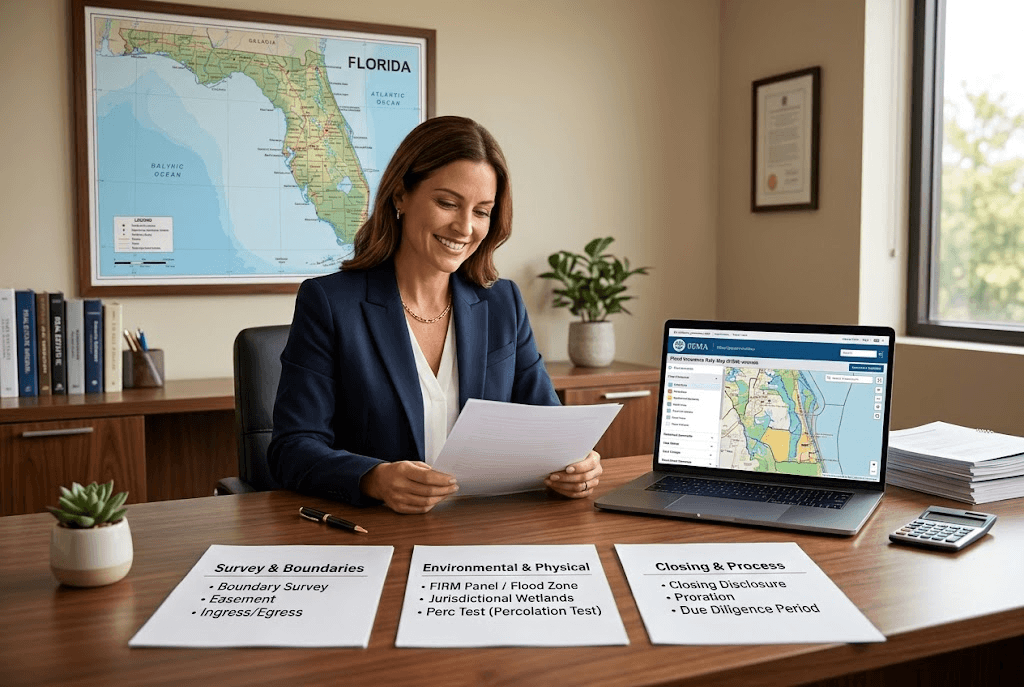
A survey performed by a licensed Florida surveyor that establishes the precise legal boundaries of a parcel and places physical markers at the corners. Confirms that the property boundaries described in the legal description match the physical location on the ground. Identifies encroachments, gaps, and overlaps with neighboring parcels. Why it matters: Satellite imagery and county maps are approximations. A boundary survey is the only document that tells you exactly where your parcel begins and ends. Commission one before closing on any rural land acquisition.
Easement
A legal right held by a third party to use a portion of another’s property for a specific purpose. Types common in Florida land: access easements (allowing ingress/egress across the parcel), utility easements (for power lines, water, or sewer), drainage easements, and conservation easements. Easements typically survive ownership transfers and bind future owners. Why it matters: An easement reduces your effective control of the parcel. A utility easement running across a parcel may prevent construction in that area. Confirm all easements through the title search and survey before closing.
Ingress/Egress
The legal right to enter (ingress) and exit (egress) a property. A parcel without legal ingress/egress — sometimes called a landlocked parcel — cannot be accessed without crossing a neighbor’s land, which requires a deeded easement. In Florida, some platted lots have “paper roads” shown on the plat that were never physically built and may not provide actual access. Why it matters: A landlocked parcel is nearly impossible to develop, finance, or resell. Confirm legal access via a recorded easement or public road frontage before any offer.
Legal Description
The official written description of a parcel’s location and boundaries used in deeds, mortgages, and other legal documents. In Florida, legal descriptions typically use one of two formats: lot-block-subdivision (for platted subdivisions: “Lot 4, Block 12, Interlachen Lakes Estates, according to the plat thereof…”) or metes and bounds (for unplatted rural parcels: starting at a point, then directional distances around the perimeter). Why it matters: The legal description in the purchase agreement must exactly match the legal description in the county records. Any discrepancy creates a title problem. Verify this before closing.
Parcel ID (STRAP Number)
A unique identifier assigned by the county property appraiser to every parcel of real property in the county. In Florida, STRAP stands for Section-Township-Range-Subdivision-Parcel. The STRAP number is used to pull the county property appraiser record, verify ownership, and search official records. Different from the folio number used in some South Florida counties. Why it matters: The STRAP number is the most reliable way to verify you are researching the correct parcel — not a neighbor’s lot or a similarly described property in the same subdivision.
Environmental & Physical
FIRM Panel / Flood Zone
A Flood Insurance Rate Map (FIRM) panel, issued by FEMA, shows a parcel’s flood zone designation — the primary tool for assessing flood risk. Zone X means minimal flood hazard. Zone AE means high flood risk with mandatory flood insurance for financed structures. Zone VE is the highest-risk coastal zone. Flood zone status affects construction requirements, insurance costs, and buildability. Access FIRM panels at msc.fema.gov. Why it matters: A parcel in Zone AE or VE is not unbuildable, but it carries mandatory insurance, elevation certificate requirements, and construction constraints that materially change development economics. Check zone before price.
Jurisdictional Wetlands
Land areas classified as wetlands under the jurisdiction of the Florida Department of Environmental Protection (FDEP) and/or the U.S. Army Corps of Engineers, triggering specific permitting requirements before any development, filling, or dredging activity. A parcel may appear dry visually and still contain jurisdictional wetlands based on soil type, vegetation, and hydrological indicators. A formal wetland delineation by a qualified environmental consultant is the only way to confirm jurisdictional status. Why it matters: Development on jurisdictional wetlands without permits is a federal violation. The cost of a delineation ($500–$2,000) is negligible compared to the cost of building on wetlands unknowingly.
Perc Test (Percolation Test)
A soil test that measures how quickly water drains through the soil, used to determine whether a parcel can support a septic system. Required by Florida Department of Health when a property will use an onsite sewage treatment and disposal system (OSTDS). Parcels that fail a perc test cannot support a standard septic system without engineered alternatives, which add significant cost. Why it matters: If utility sewer is not available at the parcel boundary, septic feasibility depends on perc test results. A failed perc test can make a parcel effectively undevelopable for residential use.
Setback Requirements
The minimum distances that a structure must be located from the parcel’s property lines, right-of-way, water bodies, or other designated features. Set by county zoning code and can vary by structure type and zoning district. Front, rear, and side setbacks effectively reduce the buildable area of a parcel — a small lot with aggressive setbacks may have very limited usable building envelope. Why it matters: Before assuming a parcel can support a specific structure size, map the setbacks against the parcel dimensions to confirm the building envelope is adequate for your intended use.
Closing & Process
Closing Disclosure
A document itemizing all costs associated with a real estate transaction — purchase price, prorated property taxes, title insurance premiums, recording fees, and any credits or adjustments. Provided by the title company prior to closing. Review every line item before closing day to avoid surprises at the table. Why it matters: The closing disclosure tells you exactly how much money you need to bring to closing and where every dollar goes. Discrepancies between the purchase agreement and the closing disclosure should be resolved before — not during — closing.
Proration
The allocation of ongoing costs — primarily property taxes and HOA fees — between the seller and buyer based on the closing date. In Florida, property taxes are paid in arrears. At closing, the seller typically credits the buyer for the portion of the current year’s taxes attributable to the seller’s ownership period (January 1 through the day before closing). Why it matters: The tax proration credit reduces your cash due at closing. Verify that it is calculated correctly in the closing disclosure based on the actual tax bill — not an estimate.
Due Diligence Period
The contractually defined window after signing the purchase agreement during which the buyer may inspect the property, verify information, and exit the transaction without penalty if material issues are found. Typically 7 to 30 days for vacant land transactions. The scope of due diligence rights — what the buyer may investigate and what triggers the right to exit — should be explicitly defined in the purchase agreement. Why it matters: Due diligence period is the buyer’s most valuable contractual protection. Use it fully. Do not waive it to speed up closing.
Remote Online Notarization (RON)
A Florida-authorized process allowing notarization to be performed via live audio-video technology, enabling buyers and sellers to sign and notarize closing documents without being physically present in Florida. Florida was one of the early states to authorize RON, making it a practical closing option for out-of-state and international buyers. Why it matters: As a Land By Owner buyer, you do not need to travel to Florida to close. RON makes a fully remote closing legally valid — confirm the title company and notary are RON-authorized before scheduling.
Title Commitment
A document issued by the title insurance company prior to closing, committing to issue an owner’s and/or lender’s title insurance policy upon closing — subject to the conditions and exceptions listed in Schedule B. Schedule B exceptions are items the policy will not cover. Review Schedule B carefully — some exceptions are standard, others indicate unresolved title issues. Why it matters: The title commitment shows what the title company found in its search. Exceptions in Schedule B that go beyond standard items — existing liens, easements, or unresolved matters — require attention before closing.
Escrow
An arrangement in which a neutral third party (escrow agent, title company) holds funds or documents on behalf of the parties in a transaction until specific conditions are met. At closing, the buyer’s funds are held in escrow until the deed is properly executed and recorded, then disbursed to the seller. In seller-financed transactions, escrow may also refer to a reserve account held for property taxes and insurance. Why it matters: Funds wired to escrow are protected — they are not released to the seller until all closing conditions are met. Wire to the title company’s escrow account, never directly to the seller.
Payoff Statement
A written statement from the lienholder or CFD seller specifying the exact amount required to satisfy the outstanding obligation in full as of a specific date, including principal balance, accrued interest, any fees, and per-diem interest for the days after the statement date. Required when refinancing, reselling, or paying off a CFD early. Why it matters: Request a formal payoff statement — not an estimate — at least 10 to 14 days before your intended payoff date. The per-diem interest calculation means the payoff amount changes every day.
Use this glossary before you need it
The buyers who close without surprises are the ones who understood these terms before they were in a transaction under time pressure. A due diligence period that expires, a title issue that surfaces three days before closing, a forfeiture clause you did not read — these are problems that knowledge prevents.
At Land By Owner, private sellers transact directly with entity buyers. The process is transparent, the documentation is structured, and seller financing is available to qualified LLC buyers who come prepared. If a term in your purchase agreement or CFD is not on this list, ask before you sign.
.